Stuck With Your Thoughts All Day
If you're housebound or bedridden with CFS, you know what it's like to be alone with your thoughts for hours. Days. Weeks. Your mind races, worries, catastrophizes. And there's no off switch.
When you can't work, can't socialize, can't exercise, and sometimes can't even watch a screen, your brain has nothing to do except think. And when your nervous system is already in overdrive, those thoughts tend to spiral toward fear, frustration, and hopelessness. If you're dealing with chronic fatigue syndrome or a related condition, this pattern is extremely common.
Miguel spent years in that exact situation. He needed something to get those thoughts out of his head and onto paper. Not as therapy. Just as a release valve. A way to stop the thoughts from cycling endlessly with nowhere to go.
That's where journaling came in. Not fancy journaling. Not gratitude lists or morning pages or any structured system. Just writing down whatever was in his head. The good thoughts, the bad thoughts, the dreams, the fears. All of it.
A form of writing where you put your deepest thoughts and feelings onto paper without worrying about grammar, structure, or audience. Research by Pennebaker (1997) found that expressive writing reduces stress, lowers cortisol, and helps people process difficult emotions more effectively.[1]
A Letter to My Future Self
On August 19th, 2017, Miguel was having one of his worst nights. He couldn't turn over in bed. He could barely make it through the day lying down. And he decided to write a letter to his future self.
This is what he wrote:
In the letter, he wrote to his future self about how lucky that person would be. He described the simple things he missed most: going for a slow walk outside, smelling the fresh air, driving with the windows down and good music playing. He couldn't even get out of bed at the time. He missed being able to laugh, to express himself, to hug his girlfriend. But he told his future self to go do something he wanted to do. To do it for the version of himself who couldn't.
He wrote that letter hoping for a miracle he wasn't sure would come. Today, he can do everything he described. He lives a normal life. He runs a company. He exercises daily. He laughs whenever he wants.
That letter became one of his most powerful reminders of where he started and how far he came. And when he reads it now, it puts everything in perspective.
The Power of Getting It On Paper
When thoughts stay in your head, they loop. The same worries play over and over. The same fears gain momentum. Getting them on paper breaks that loop.
It doesn't matter what you write. It could be how you're feeling. Things you want to do. Foods you miss eating. Places you want to visit. Drawings. Lists. Letters to people. Letters to yourself.
Miguel kept stacks of journals. They had everything: ideas, dreams, detailed visualizations of what he wanted his life to look like after recovery, and raw accounts of his worst moments. Not because he had a plan for them, but because writing was the only way to get the noise out of his head.
The additional benefit? When you do recover, those journals become proof. Proof of where you were, what you were thinking, and how far you've come. They make the gratitude real because the evidence is right there in your own handwriting.
Visualization as a Recovery Tool
Beyond writing, visualization became a daily practice. Not in a structured meditation sense, but as a way to take his mind somewhere else when the present moment was unbearable.
The key is detail. Not just "I want to go to the beach." Instead: What does the air smell like? What does the wind feel like on your face and in your hair? What's the temperature? Who are you with? What music is playing? The more vivid the detail, the more your mind actually goes there.
Pick a scene you want to experience
A walk outside, a drive with the windows down, dinner with friends. Something that feels meaningful to you.
Write down every sensory detail
What do you see, hear, smell, and feel? What's the temperature? What textures are around you? Write it like you're actually there.
Read it back and visualize it fully
Close your eyes and step into the scene. Let your mind create the experience. This pulls your attention away from symptoms and fear.
Keep a collection of these scenes
Build a library of visualizations you can return to on hard days. They become anchors that remind you where you're headed.
Research on mental imagery supports this approach. Visualization activates many of the same neural pathways as actually performing an activity, which can support the nervous system retraining process.[2]
The Turning Point in Every Recovery
The recovery journey doesn't follow a straight upward line. It goes down, then down more, then down further. Just when you think it's getting better, it drops again. You know this if you've been in it. You know what it feels like to get a glimpse of progress and then have the rug pulled out.
But at some point, there's a turning point. A moment where the decline stops and things start moving in the other direction. Slowly at first. Then with more momentum.
That turning point separates the old version of you from the new version. The person who was getting sicker from the person who's getting better. And when you look back from the other side, you can see exactly where it happened. We call this a mindshift.
You don't always know you're at the turning point when you're in it. Sometimes it only becomes clear looking back. But it's there. And for thousands of people, it came.
The Mindset Shift That Changes Everything
One of the most important things Miguel emphasizes: the mindset that got you into this illness is not the mindset that gets you out.
The overthinking, the emotional reactivity, the need to control everything, the pattern of pushing past your limits. That's the old operating system. Recovery requires building a completely different one.
That new mindset includes calmer responses to symptoms, better emotional regulation, understanding how the nervous system works, and a willingness to trust the process even when you can't see the end.
The mindset that got you into this illness isn't the mindset that can get you out. You need a completely different way of thinking to move forward.
Journaling and visualization are tools that help build that new mindset. They give you an outlet for the old patterns while training your brain to focus on something constructive. They don't replace the brain retraining work. But they support it in a real, practical way.
So if you're stuck right now and you've got time (which you probably do), grab a notebook. Write down what you're feeling. Write a letter to your future self. Describe in vivid detail the life you want to live. You might not believe it'll happen. That's fine. Write it anyway. One day, you'll read it back and realize you made it.
Watch the Full Video
In this video, Miguel reads his actual journal entry from 2017 and shares the full story of how journaling and visualization helped him survive the darkest period of his CFS journey.
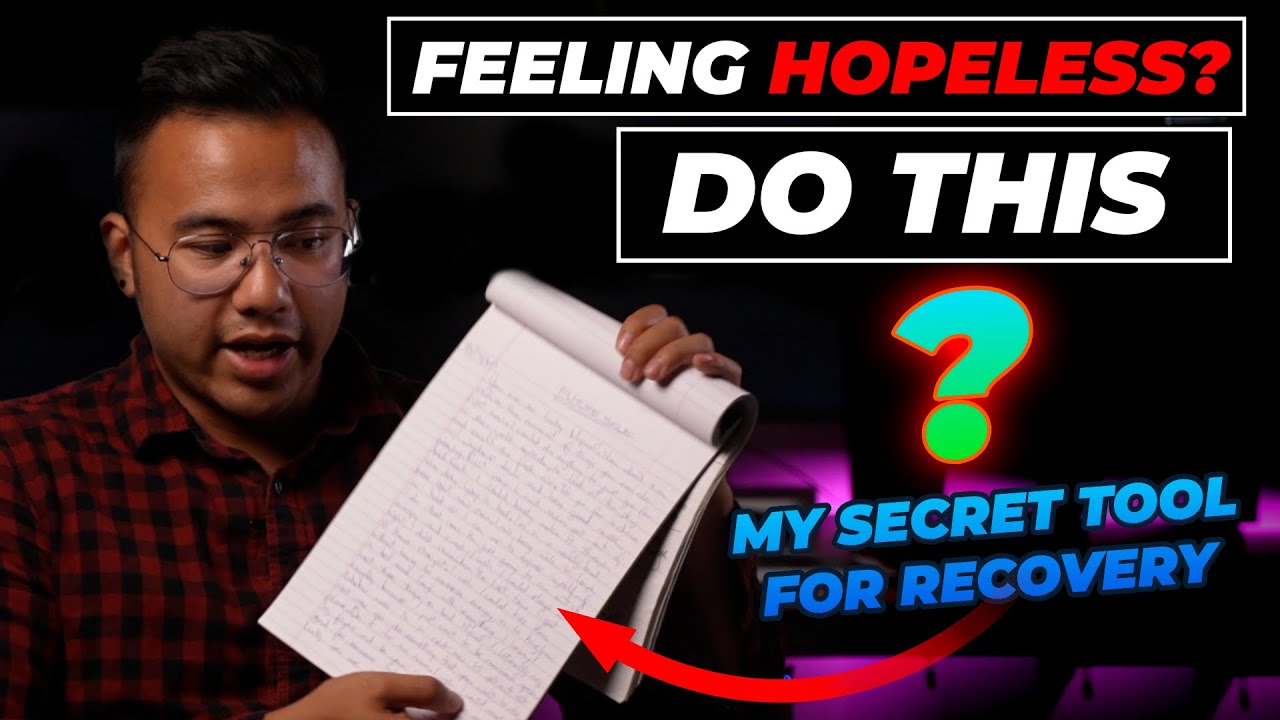
Watch: How to Stay Inspired and Hopeful During CFS Recovery
TL;DR Summary
- Being stuck with your thoughts all day makes everything harder. Journaling breaks the loop
- Writing letters to your future self creates hope and becomes powerful proof of progress
- Visualization with vivid sensory detail redirects your mind away from fear and symptoms
- Recovery isn't a straight line up. It goes down before it goes up, with a turning point in the middle
- The mindset that got you sick is not the mindset that gets you better. Recovery builds a new one
- Even if you don't believe recovery is possible right now, write it down anyway
Sources and References
- Pennebaker JW. "Writing about emotional experiences as a therapeutic process." Psychological Science. 1997. PubMed 9433091
- Ridderinkhof KR, Brass M. "How kinesthetic motor imagery works: a predictive-processing theory of visualization in sports and motor expertise." Journal of Physiology. 2015. PubMed 25620797
- Doidge N. The Brain That Changes Itself. Penguin Books, 2007. PubMed Review
- Smyth JM, Johnson JA, Auer BJ, et al. "Online positive affect journaling in the improvement of mental distress and well-being." JMIR Mental Health. 2018. PubMed 30530460