The Gap Between Where You Are and Where You Want to Be
There's a gap. On one side is where you are now: struggling with symptoms, surviving, watching every move you make because the wrong one could send you into a flare-up. On the other side is where you want to be: thriving health, no limitations, not walking on eggshells every day.
Everyone who's dealing with CFS, long COVID, fibromyalgia, or related conditions knows this gap exists. The question is: how do you close it? And that's where things get complicated. Because every time you try to move toward your goal, something painful happens.
You try to add more activity. You flare up. You try to reintegrate into social life. You flare up. You try to work, to exercise, to do anything that a normal person does. And your body says no. Over and over.
Fire in the Middle of the Room
Picture this. You're on one side of a room. Your goal is on the other side. But every time you walk to the middle, there's fire. Heat, pain, discomfort. You touch the flame and it burns. So you go back to where you started.
Then you try again. Same thing. Fire. Pain. You try going around it, over it, through it. Nothing works. It just keeps burning you. And each time it burns, the memory gets stronger. The fear gets deeper.
A pattern where the brain creates strong associations between a stimulus (activity) and a negative outcome (flare-up). After enough repetitions, the brain triggers the fear and even the physical symptoms before the activity happens, as a protective measure.[1]
This isn't weakness. It's how the brain is designed to work. If you touch a hot stove enough times, you stop touching it. Your brain is doing its job. The problem is that in CFS, it's doing its job too well. It's creating protective responses that are now keeping you stuck instead of keeping you safe.
When Your Brain Starts Anticipating the Pain
After enough bad experiences, something shifts. You don't even have to do the activity anymore. Just thinking about it triggers the symptoms.
Miguel experienced this firsthand. Just thinking about running would increase his heart rate. Imagining sitting in a doctor's office with fluorescent lights would trigger a headache and brain fog before he even got there. The thoughts themselves were producing real physical symptoms.
This happens because the association between activity and pain becomes so strong that the brain preemptively activates the alarm system. It doesn't wait for actual danger. It sees the possibility of danger and responds as if it's already happening.[2]
The person on the other side of the room doesn't even need to see the fire anymore. They've experienced it so many times that their brain creates the fire for them. The heat, the pain, the dread. It's all generated internally now. And it feels completely real.
Why Staying Stuck Feels Safer
At some point, the math changes. Why would you keep trying if every attempt ends in pain? Why expose yourself to failure when staying still is pain-free?
This is where people end up in forums and Facebook groups saying recovery isn't possible. They're not making that claim out of spite. They're speaking from genuine experience. They've tried. Multiple times. And every time, it went badly.
Imagine sitting on one side of a room and needing to get to the other side. But every time you reach the middle, there's fire, heat, and pain. At some point, it's actually easier to just sit still and not even try. Why would you expose yourself to the option of failure and pain again?
Add to that the broken trust from doctors, supplements, medications, and other programs that promised results and didn't deliver. Every failed attempt makes the next one harder to try. Eventually, hopelessness feels more logical than hope.
This is a predictable nervous system pattern. It's not a character flaw. Understanding that is the first step toward changing it. Learning what brain retraining actually is shows you how to start reversing this pattern.
The Amygdala and Emotional Intensity
All of this comes back to one part of the brain: the amygdala. It's the alarm center. And in CFS, it's running on overdrive.
Research suggests stronger emotions tend to mean more amygdala activity, and more amygdala activity can mean more nervous system hypersensitivity. This is the core pattern we keep seeing.
When the amygdala is overactive, brain activity concentrates there while other areas go quiet. That's why you can feel emotionally hijacked during flare-ups. Fear, panic, and mood swings are amplified because the logical parts of the brain aren't getting enough activity to counterbalance the alarm response.[3]
Think about this: you've done the same activity on different days and gotten completely different results. Some days you went for a car ride and felt fine. Other days you did less and flared up five times worse. Same activity, wildly different outcomes.
Often the difference came down to more than the physical activity. The emotional state mattered too. On good days, you were calmer. On bad days, fear and worry were already elevated. In our experience, emotional intensity can play a big part in the symptom response, not just the physical load.[3] The research behind this shows measurable changes in amygdala activity connected to symptom severity.
The Water Suit: How Neuroplasticity Changes the Equation
What if you didn't have to suffer through every flare-up? What if there was a way to walk through the fire without getting burned as badly?
That's what neuroplasticity makes possible. Instead of going through the fire barefoot and unprotected, you put on a water suit. And you pour water on yourself the entire way through.
In practical terms, that water suit is the ability to bring logic back into the equation during a flare-up. When symptoms rise and emotions start building, you remind yourself: "This is just the nervous system." That simple act neutralizes the emotional intensity, reduces amygdala activity, and keeps the logical parts of the brain online.[4]
Recognize the pattern
Notice when emotions are rising alongside symptoms. The fear, the worry, the "what if this gets worse." That escalation is the amygdala taking over.
Bring logic in
Remind yourself: "This is the nervous system doing its thing. I've been through this before. It passes." That simple statement shifts brain activity from the amygdala toward the prefrontal cortex.
Reduce emotional fuel
As you lower the emotional intensity, the symptoms lose their amplifier. The flare-up still happens, but it's less intense and passes more quickly.
Repeat until the association rewires
Each time you move through a flare-up with a calmer response, you're building new neural pathways. Over time, the brain stops treating normal activity as a threat.
Recovery doesn't have to be such a grind. You can learn to smile and dance in the rain. Adjustment periods are on the way to recovery, not in the way of it. Understanding how to get through a flare-up makes navigating these moments much easier.
This doesn't mean the fire disappears. Flare-ups are part of recovery. There's no way to expand your capacity without some discomfort, just like there's no way to build muscle without some soreness. But when you have the tools to move through those flare-ups without the full emotional weight, the entire equation changes.
Miguel went from bedridden and spoon-fed in the ICU to hiking mountains ten months later. Not because he powered through. Because he learned to work with his nervous system instead of against it. And that same approach has produced over 3,000 documented wins from people around the world.
You don't have to jump into the deep end. You dip your toes in first. You feel the water. You build from there. And with the right understanding and the right support, the fire that once seemed impossible to cross becomes something you can navigate. One step at a time. See your recovery options to find the right starting point.
Watch the Full Video
In this video, Miguel walks through the full fire analogy, explains why people get stuck, and shows exactly how neuroplasticity and better symptom response change the equation. If you've been stuck or close to giving up, this is worth watching.
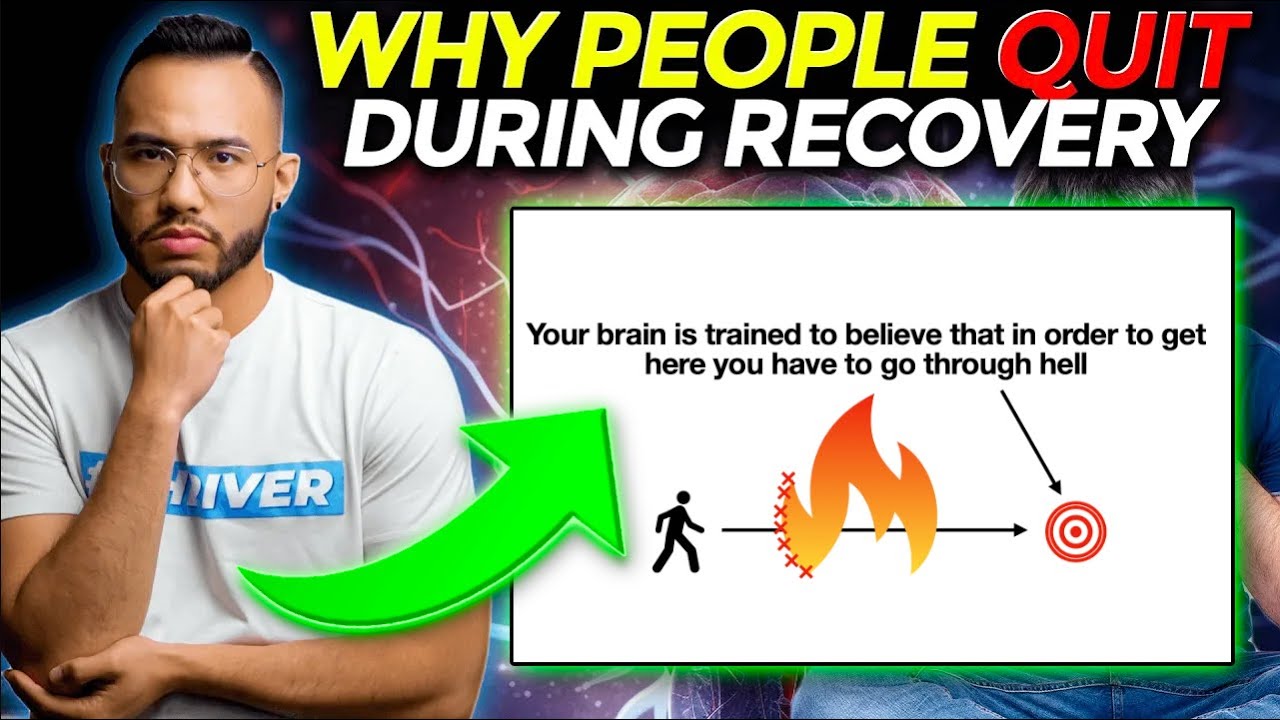
Watch: Why People Quit During CFS Recovery
TL;DR Summary
- Repeated flare-ups train the brain to expect pain, creating a learned fear response
- Eventually, the brain anticipates symptoms before you even do the activity
- Staying stuck starts to feel safer than trying again. This is a nervous system pattern, not a failure
- Emotional intensity drives amygdala activity, which drives symptom severity
- Neuroplasticity allows you to rewire the pattern by bringing logic into flare-ups
- Adjustment periods are part of recovery. Moving through them with calmer responses is the key
Sources and References
- LeDoux JE, Pine DS. "Using neuroscience to help understand fear and anxiety: a two-system framework." American Journal of Psychiatry. 2016. PubMed 27609244
- Shin LM, Rauch SL, Pitman RK. "Amygdala, medial prefrontal cortex, and hippocampal function in PTSD." Annals of the New York Academy of Sciences. 2006. PubMed 16855159
- Vyas A, Mitra R, Shankaranarayana Rao BS, Bhatt S. "Chronic stress induces contrasting patterns of dendritic remodeling in hippocampal and amygdaloid neurons." Journal of Neuroscience. 2002. PubMed 12427850
- Porges SW. "The polyvagal theory: new insights into adaptive reactions of the autonomic nervous system." Cleveland Clinic Journal of Medicine. 2009. PubMed 19376977
- Doidge N. The Brain That Changes Itself. Penguin Books, 2007. PubMed Review