Heart Palpitations With CFS: Why Your Heart Won't Calm Down
Your heart is pounding. You can feel it in your chest, your throat, your ears. You stood up from the couch and your heart rate shot to 130. You're lying in bed doing nothing and your chest is thumping. Every spike sends a wave of fear through your body: is something wrong with my heart?
You've had tests. Your ECG came back normal. Your Holter monitor looked fine. But the palpitations keep happening. And every time they do, it feels like your heart is about to give out.
If your cardiac tests have come back clear, your nervous system may be stuck in overdrive, flooding your body with adrenaline it doesn't need.
What You'll Learn On This Page
- Heart palpitations with CFS are often a nervous system symptom, not necessarily a sign of heart disease or cardiac failure
- POTS (heart rate spiking when you stand up) is extremely common in CFS and driven by autonomic nervous system dysfunction
- Heart rate monitors often make it worse by creating an anxiety feedback loop that raises your heart rate further
- Your heart can handle temporary spikes. It beats roughly 100,000 times per day. A few hours of elevated rate won't cause damage
- Palpitations improve when the nervous system calms down. Thousands of people in our community have reported this symptom resolving during recovery
What Do Heart Palpitations With CFS Feel Like?
Heart palpitations in CFS involve your heart rate spiking, pounding, or racing in situations where it shouldn't. This is one of the most common symptoms in people dealing with CFS, long COVID, and related conditions. Research has documented a strong overlap between ME/CFS and autonomic nervous system dysfunction, including POTS (Hoad et al., 2014). Research suggests it may not be a heart condition, but rather a nervous system condition that shows up in the heart.
If you have CFS, you probably know exactly what this feels like.
You stand up from sitting and your heart rate jumps to 120, 130, 140. You roll over in bed and feel your chest pounding. You're just lying there doing nothing and you can feel your pulse in your ears. Sometimes it stays elevated for hours. Sometimes for days. And the worst part is the fear it creates, because every single spike makes you wonder if something is seriously wrong.
For many people, it comes with other symptoms. Dizziness, lightheadedness, a feeling like you might pass out. Sometimes it triggers a rush of adrenaline that makes your hands shake and your thoughts race. Sometimes it spirals into a full panic attack.
The specifics vary person to person, but the pattern is consistent:
- ● Heart rate spiking when standing, sitting up, or changing position
- ● Feeling your heart pounding in your chest, throat, or ears
- ● Heart rate that stays elevated for hours or days at a time
- ● Adrenaline surges that come with the heart rate spikes
- ● Dizziness, lightheadedness, or feeling like you'll pass out
- ● Fear and anxiety about the heart rate, which then raises it even more
If your cardiac tests come back normal but your heart keeps racing, that's not "nothing." That's your nervous system telling you it's stuck in protection mode.
Why Heart Palpitations Happen With CFS
Heart palpitations aren't random. They make complete sense when you understand what your nervous system is doing.
Your body's job is to adapt to changing environments. When you stand up, your nervous system adjusts blood pressure and heart rate to make sure blood gets to your brain. That's normal. In a healthy system, your heart rate goes up slightly, maybe to 90 or 100, and settles back down quickly.
But when the nervous system is hypersensitive, it overcompensates. Massively. Instead of gently increasing your heart rate, it floods your system with adrenaline as if you need to sprint away from a predator. Your heart rate shoots to 130, 140, 150. Even rolling over in bed might trigger that same response, because the nervous system has lost its sense of proportion.
This is what POTS (Postural Orthostatic Tachycardia Syndrome) is. It's the nervous system overreacting to position changes. And it's extremely common in CFS.
The nervous system connection
When your autonomic nervous system is stuck in fight-or-flight mode, it treats everything as a potential threat. Standing up. Sitting upright. A worrying thought. Each of these triggers the same survival response. A study in Frontiers in Neurology documented that autonomic dysfunction in ME/CFS directly affects cardiovascular regulation, explaining why heart rate becomes so volatile.
The problem gets worse because of the feedback loop. Your heart rate goes up. You notice it. You get scared. The fear triggers more adrenaline. More adrenaline raises the heart rate further. Now it's not just the original spike. It's the spike plus the fear response on top of it. Research on heart rate variability in CFS confirms that autonomic imbalance is a measurable marker of this dysfunction.
A normal trigger happens
You stand up, sit upright, walk to the kitchen, or even just have an anxious thought. Something shifts in your body's environment.
The nervous system overcompensates
Instead of a gentle heart rate adjustment, the nervous system floods your body with adrenaline. Heart rate shoots up way beyond what's needed. This is the dysregulated response.
Fear and anxiety pile on
You feel the spike and get scared. Is my heart okay? What if it gives out? That fear creates more adrenaline, which raises the heart rate even more. Now you're in a cascading loop.
The cycle reinforces itself
Every spike plants a seed of fear for the next one. The nervous system stays on high alert, primed to overreact again. The pattern continues until the underlying nervous system dysregulation is addressed.
This is also why palpitations tend to be worse during flare-ups, during periods of stress, or after overexertion. Anything that increases the nervous system's sensitivity will amplify the heart rate response.
CFS Heart Palpitations vs. Normal Heart Rate Changes
Everyone's heart rate fluctuates throughout the day. But CFS palpitations are a different experience entirely. Here's how to tell the difference:
| Normal Heart Rate Changes | CFS Heart Palpitations |
|---|---|
| Heart rate rises with exercise and settles quickly | Heart rate spikes from standing up and stays elevated for hours |
| You rarely notice your heartbeat at rest | You can feel your heart pounding in your chest, throat, or ears while lying down |
| Proportional to the activity you're doing | Wildly disproportionate to the trigger (rolling over in bed causes a spike to 140+) |
| No fear or anxiety attached to the increase | Each spike triggers fear, worry, or panic about the heart itself |
| Heart rate returns to baseline within minutes | Elevated rate can persist for days during flare-ups |
| Doesn't come with adrenaline surges or dizziness | Often paired with adrenaline rushes, dizziness, lightheadedness, or panic |
| Cardiac tests show exercise-related changes | All cardiac tests typically come back normal |
If your experience matches the right column, that's a strong signal your autonomic nervous system is involved, not your heart itself.
Watch: POTS and Heart Rate Explained
In this video, Miguel breaks down exactly why heart palpitations and POTS happen with CFS, why heart rate monitors make it worse, and what you can do about it. If you're dealing with heart palpitations right now, this will help you understand what's going on.
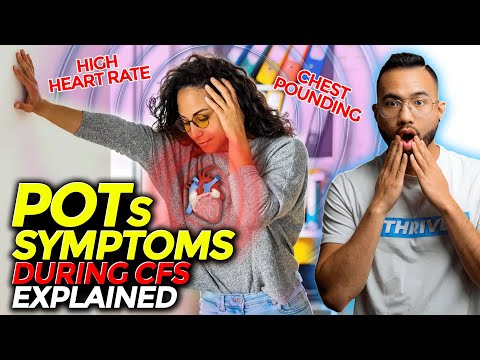
Watch: POTS, High Heart Rate, and Adrenaline Explained
What Makes Heart Palpitations Worse
Heart palpitations fluctuate. Some days are manageable. Other days your heart feels like it's running a marathon while you're lying on the couch. Understanding what triggers the worst episodes helps you see the pattern.
Using a heart rate monitor. This is the biggest one. Unless your doctor told you to wear one, take it off. Watching the numbers creates a direct anxiety feedback loop. You see the number, you get nervous, the number goes up, you get more nervous. Miguel strongly advises against heart rate monitors for this reason.
Fear about the symptom itself. Every time your heart spikes and you think "is something wrong with my heart?" you're adding fuel to the fire. That fear creates more adrenaline, which raises the heart rate further. The fear of the symptom becomes worse than the symptom itself.
Position changes. Standing up, sitting up, reaching overhead, bending down. Any position change requires the autonomic nervous system to adjust, and when it's hypersensitive, it overcompensates every time.
Stress and emotional overload. Worry, frustration, anger, even excitement. Any strong emotional state triggers the fight-or-flight response, which directly affects heart rate. During flare-ups, this effect is amplified.
Overexertion. Pushing beyond your current capacity triggers a cascade of nervous system responses. The heart rate spike after overdoing it can last hours or days as the nervous system tries to recalibrate.
What Actually Helps Heart Palpitations
Treating heart palpitations as a separate problem doesn't work. You can't calm your heart rate by focusing on your heart. The heart is just responding to signals from the nervous system. Fix the signals, and the heart calms down on its own.
That's the approach CFS Recovery takes. Instead of going after 20 individual symptoms one at a time, you address the one underlying issue: the hypersensitive nervous system. Heart palpitations, brain fog, fatigue, digestive issues, they all sit under that same umbrella. Address the umbrella, and the symptoms underneath it start to resolve.
Nervous system retraining is how people in our community have seen their heart palpitations settle. It involves systematically teaching the nervous system that safety is the default instead of threat. As the stress response calms down, the adrenaline surges become less frequent. The heart rate spikes become less intense. The recovery time between spikes gets shorter. This aligns with growing research on neuroplasticity-based approaches showing the nervous system can form new, calmer patterns when given the right inputs consistently.
This doesn't happen overnight. But it does happen. And for many people, the palpitations gradually become background noise instead of the terrifying main event.
What our clients experience
We've got over 3,000 documented client wins across our community. Many of those specifically mention heart palpitations and POTS symptoms resolving. People who couldn't stand up without their heart rate spiking to 150 are now going on walks, hiking, and exercising again.
This isn't theory. It's documented. You can hear these stories directly from the people who lived them on our recovery stories page.
If your cardiac tests come back normal and your doctors can't find anything wrong with your heart, that's actually useful information. It suggests the issue may be functional rather than structural. The nervous system may just need to learn a new pattern.
A real perspective: what Miguel's doctor told him
When Miguel was in the hospital recovering from severe CFS, he was terrified about his heart rate. It would spike just from rolling over in bed. His doctor told him something that changed his perspective: "Your heart beats about 2.5 billion times in your lifetime. A few days of elevated rate is a tiny blip. Your heart can handle it. We haven't found anything wrong. The reason it's high is because your nervous system is dysregulated, not because your heart is failing." That reframe was a turning point. Understanding that his heart may not have been the problem, that his nervous system could have been driving it, allowed the fear to drop. And when the fear dropped, the spikes got shorter.
Summary
Heart palpitations with CFS are often caused by a dysregulated autonomic nervous system rather than a heart condition. POTS (heart rate spiking when you change position) is extremely common in CFS. The nervous system overcompensates to physical stressors by flooding the body with adrenaline. Fear about the symptom creates a feedback loop that makes it worse. Heart rate monitors amplify the anxiety. When the underlying nervous system pattern is addressed through retraining, the palpitations typically settle. Your heart can handle temporary spikes. It's built for it.
Sources and References
- Hoad A, Spickett G, Elliott J, Newton J. "Postural orthostatic tachycardia syndrome is an under-recognized condition in chronic fatigue syndrome." QJM. 2014. PubMed 24755258
- Shan ZY, Finegan K, Bhuta S, et al. "Brain function characteristics of chronic fatigue syndrome: a task fMRI study." Frontiers in Neurology. 2020. PubMed 33002030
- Nelson MJ, Bahl JS, Buckley JD, et al. "Evidence of altered cardiac autonomic regulation in myalgic encephalomyelitis/chronic fatigue syndrome." Medicine. 2019. PubMed 31574513
- Gulyaeva NV. "Neuroplasticity and recovery of function: molecular mechanisms and therapeutic approaches." Biochemistry (Moscow). 2022. PubMed 35164308
Frequently Asked Questions About Heart Palpitations and CFS
Heart palpitations from CFS are often driven by a dysregulated nervous system rather than a heart condition. Once your doctor has ruled out cardiac issues through tests like an ECG or Holter monitor, a high heart rate from nervous system hypersensitivity is uncomfortable but not dangerous.
Your heart is built to handle temporary increases. It beats roughly 100,000 times per day. Temporary spikes are a small fraction of that.
POTS stands for Postural Orthostatic Tachycardia Syndrome. It means your heart rate spikes when you change position, like standing up from sitting. It's extremely common in people with CFS because the nervous system overcompensates to physical stressors.
Your body sends a surge of adrenaline even for small movements because it's stuck in a protective mode. POTS is commonly a nervous system issue rather than a heart defect.
Unless your doctor has specifically told you to monitor your heart rate, it's better to avoid it. Watching the numbers creates anxiety, which raises your heart rate further, which creates more anxiety. It becomes a feedback loop that makes the symptom worse.
Removing the monitor takes away the trigger for that loop. It's one of the simplest and most impactful changes you can make.
When the nervous system is stuck in fight-or-flight mode, it can spike your heart rate even without physical movement. Thoughts, emotions, and internal stress responses can trigger adrenaline surges that raise your heart rate while you're at rest.
If your cardiac tests are clear, it's likely the nervous system's overreaction rather than a sign that something is wrong with your heart. As the nervous system calms through retraining, these resting spikes often become less frequent.
Yes. Heart palpitations driven by nervous system dysregulation can improve as the nervous system calms down. CFS Recovery has documented thousands of client wins, and heart palpitations resolving is one of the commonly reported improvements.
When the stress response settles, the body stops overcompensating, and heart rate stabilizes.
The most helpful thing during a heart rate spike is to avoid adding fear to the situation. Fear and panic create more adrenaline, which raises the heart rate further.
Remind yourself it's the nervous system, not your heart. Stay as calm and neutral as you can. The spike will pass on its own. Over time, as the nervous system retrains, the spikes become less frequent and less intense.
Your Heart Can Settle. The Palpitations Can Calm Down.
Thousands of people in our community have experienced their heart palpitations resolving as their nervous system calmed down. With coaching from people who've recovered themselves, you'll understand why it's happening and what to do about it.
Take the Free Self Assessment →