Anxiety With CFS: Why Every Symptom Feels Like a Threat
A muscle twitches and your brain goes straight to the worst-case scenario. Your heart rate spikes and you're convinced something is seriously wrong. You feel a new sensation in your body and within seconds you're Googling it, looking for answers that never come. The anxiety isn't just about your health. It's about everything. And it doesn't stop.
You're not overreacting. You're not "just anxious." Your nervous system is stuck in survival mode, and it's treating every signal from your body like a fire alarm.
Your nervous system may be stuck in threat-detection mode, amplifying everything to keep you "safe."
What You'll Learn On This Page
- CFS-related anxiety is often a nervous system symptom, not necessarily a personality trait or a separate mental health diagnosis
- Your nervous system has a "magnifying glass effect" that makes every symptom and sensation feel 10 times worse than it actually is
- Catastrophizing about symptoms is a survival response, not irrational thinking. Your brain is doing what it's designed to do under threat
- Treating anxiety as a separate problem doesn't work. It improves when the nervous system shifts out of chronic survival mode
- Anxiety can improve significantly. Thousands of people in our community have experienced it calming down during recovery
What Does CFS Anxiety Actually Feel Like?
Anxiety with CFS goes far beyond normal worry. It's a constant state of hyper-alertness where your nervous system treats every bodily sensation as a potential emergency. Research has found a strong connection between autonomic nervous system dysfunction and anxiety in people with ME/CFS (Newton et al., 2012). It's also common in long COVID, fibromyalgia, and POTS. This isn't a mental weakness. It's a nervous system that's stuck in overdrive.
If you have CFS, you probably know exactly what this feels like.
You feel a twinge in your leg and your brain immediately tells you it's a blood clot. Your heart rate goes up after walking to the kitchen and you're convinced your heart can't handle it. You cry during a movie and wonder if you're losing control of your emotions. Every new sensation gets fed through a filter that amplifies it and attaches a worst-case scenario to it.
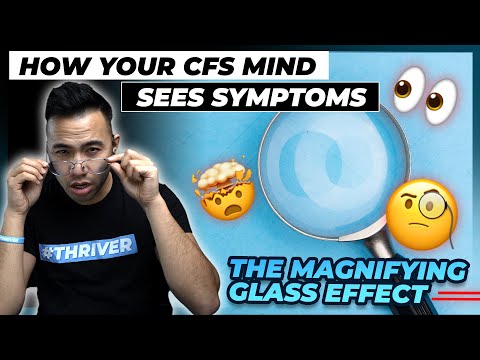
Miguel calls this the "magnifying glass effect." When your nervous system is stuck in survival mode, it holds a magnifying glass over every sensation, every thought, every emotion. Everything looks bigger, scarier, and more dangerous than it actually is.
The specifics vary person to person, but the pattern is consistent:
- ● Constantly scanning your body for new or changing symptoms
- ● Jumping to worst-case scenarios about what symptoms mean
- ● Feeling panicky after minor physical exertion
- ● Googling symptoms obsessively looking for reassurance
- ● Heart palpitations, chest tightness, shortness of breath during anxious episodes
- ● Emotional sensitivity that feels out of proportion (crying easily, overreacting to small things)
If your doctors say nothing is wrong but your body keeps setting off alarm bells, that's not "nothing." That could be your nervous system stuck in a pattern of threat detection.
Why Anxiety Happens With CFS
The anxiety isn't random. It makes complete sense when you understand what your nervous system is doing.
Your brain is wired for survival. It has built-in systems designed to detect danger and protect you from it. In a healthy state, these systems activate when there's a real threat and then turn off when the threat passes. With CFS, the system gets stuck in the "on" position. Your brain is running threat detection 24 hours a day, 7 days a week.
When the brain is in this high-alert state, it doesn't just look for real dangers. It starts treating normal sensations as dangerous too. A sore muscle after walking becomes "something is wrong with my legs." A slightly fast heart rate becomes "my heart can't handle this." An emotional response to a movie becomes "I'm losing my mind."
That's the magnifying glass effect. The stressed nervous system takes a normal sensation, runs it through the survival filter, and spits out a worst-case interpretation. And it does this hundreds of times a day.
The nervous system connection
When your nervous system is stuck in fight-or-flight mode, it prioritizes threat detection over everything else. A systematic review has confirmed that autonomic nervous system dysfunction is a consistent finding in ME/CFS. This dysregulation directly drives the anxiety response.
Your nervous system and your emotional state are completely linked. When the nervous system is in overdrive, the brain becomes hypersensitive to all stimuli. Physical sensations get amplified. Emotions feel bigger. Thoughts race faster. This isn't a character flaw. It may be a nervous system running a survival program that's no longer needed.
Your nervous system gets stuck in survival mode
Illness, stress, or trauma pushes the nervous system into fight-or-flight. Instead of turning off after the threat passes, it stays activated. The brain starts scanning for danger constantly.
The magnifying glass turns on
Normal bodily sensations get filtered through the survival lens. Everything looks bigger and scarier. A muscle twitch becomes a neurological condition. A fast heart rate becomes a cardiac event. The brain jumps to worst-case scenarios automatically.
The anxiety creates more symptoms
The fear and worry generated by catastrophizing activates the stress response further. This produces real physical symptoms: heart palpitations, chest tightness, dizziness, nausea. These new symptoms then get fed back through the magnifying glass.
The cycle reinforces itself
More symptoms mean more anxiety. More anxiety means more nervous system activation. More activation means more sensitivity to symptoms. The loop keeps going until the pattern is interrupted.
This is also why the anxiety tends to spike during flare-ups or after exertion. When the nervous system is more activated, the magnifying glass gets stronger, and everything feels more threatening.
CFS Anxiety vs. Regular Anxiety
Everyone experiences anxiety sometimes. But CFS anxiety is fundamentally different from everyday stress or nervousness. Here's how to tell the difference:
| Regular Anxiety | CFS Anxiety |
|---|---|
| Triggered by specific situations (exams, interviews, conflict) | Triggered by normal bodily sensations with no external threat |
| Subsides when the situation passes | Persists because the body is always producing new sensations to worry about |
| You can usually talk yourself down with logic | Logic feels impossible when the survival response is activated |
| Physical symptoms are mild and temporary | Produces intense physical symptoms (palpitations, chest tightness, dizziness) |
| Doesn't usually change your perception of normal sensations | Makes every normal sensation feel amplified and dangerous |
| Manageable with basic relaxation or distraction | Can feel all-consuming and beyond conscious control |
| Not connected to a broader pattern of physical symptoms | Part of a larger pattern of nervous system dysregulation (fatigue, pain, brain fog) |
If your experience matches the right column, that's a strong signal that your nervous system is driving the anxiety, not just your thoughts.
Watch: Anxiety and CFS Explained
In this video, Miguel breaks down the magnifying glass effect, explains why CFS makes you anxious about your symptoms, and shares what helped him move past the constant fear during his own recovery.
Watch: Dealing with Anxiety About Symptoms
What Makes CFS Anxiety Worse
Anxiety fluctuates. Some days it's manageable. Other days it feels like you can't take a breath without your brain attaching a worst-case scenario to it. Understanding what triggers the worst episodes helps you make sense of the pattern.
Symptom monitoring. The more you scan your body for symptoms, the more you find. And the more you find, the more fuel you give the anxiety. This creates a feedback loop where monitoring becomes compulsive because it feels like the only way to stay safe.
Googling symptoms. Searching for reassurance online almost always makes things worse. You find scary possibilities, which triggers more fear, which triggers more searching. The reassurance never lasts because the underlying nervous system pattern hasn't changed.
Flare-ups and new symptoms. When symptoms spike or something new appears, the magnifying glass gets bigger. The brain interprets the change as evidence that something is getting worse, which escalates the anxiety response.
Physical exertion. Activity increases heart rate, produces muscle sensations, and changes how your body feels. When the nervous system is hypersensitive, these normal post-exertion sensations get flagged as dangerous.
Isolation and lack of understanding. When the people around you don't understand what you're going through, the anxiety gets worse. Feeling unseen or dismissed adds emotional stress on top of the physical symptoms.
What Actually Helps CFS Anxiety
Treating anxiety as a separate problem doesn't address the root cause. You can't think your way out of a nervous system response with logic alone, and you can't relax your way out of it with deep breathing alone. The anxiety is one symptom within a larger pattern. When that pattern shifts, the anxiety calms down.
That's the approach CFS Recovery takes. Instead of going after anxiety, brain fog, fatigue, and pain as separate problems, you address the one underlying issue: the hypersensitive nervous system. All of these symptoms sit under that same umbrella. Calm the nervous system, and the magnifying glass gets smaller. The anxiety response naturally reduces.
Nervous system retraining is how people in our community have moved past the constant anxiety. It involves systematically teaching the nervous system that safety is the default instead of threat. As the brain learns that normal sensations aren't dangerous, the catastrophizing slows down. The magnifying glass effect weakens. The anxiety response calms. Research on neuroplasticity-based interventions supports that the brain can rewire fear responses when given consistent new inputs.
This doesn't happen overnight. But it does happen. And for many people, the reduction in anxiety is one of the most life-changing parts of recovery.
What our clients experience
We've got over 3,000 documented client wins across our community. Many of those specifically mention the anxiety lifting. People who couldn't leave the house without a panic attack are now living normal lives again. People who spent hours Googling symptoms are now responding to sensations with calm instead of fear.
This isn't theory. It's documented. You can hear these stories directly from the people who lived them on our recovery stories page.
If your tests come back normal and your doctors keep saying there's nothing physically wrong, that's actually useful information. It suggests the issue may be functional rather than structural. The nervous system may just need to learn a new pattern. One where safety is the default, not threat.
Summary
Anxiety with CFS is driven by a nervous system stuck in survival mode. It creates a "magnifying glass effect" that amplifies every bodily sensation and turns it into a worst-case scenario. This isn't irrational thinking. It's a stressed nervous system doing what it's designed to do under perceived threat. The anxiety gets worse with symptom monitoring, Googling, flare-ups, and exertion. It improves when the underlying nervous system pattern is addressed through retraining. As the magnifying glass gets smaller, the anxiety naturally calms down.
Sources and References
- Newton JL, Okonkwo O, Sutcliffe K, et al. "Symptoms of autonomic dysfunction in chronic fatigue syndrome." QJM: An International Journal of Medicine. 2007. PubMed 22370665
- Nelson MJ, Bahl JS, Buckley JD, et al. "Evidence of altered cardiac autonomic regulation in myalgic encephalomyelitis/chronic fatigue syndrome: a systematic review and meta-analysis." Medicine. 2019. PubMed 33573776
- Daniels J, Brigden A. "Health anxiety in chronic fatigue syndrome: the role of symptom focusing and cognitive distortion." Journal of Psychosomatic Research. 2017. PubMed 29318846
- Marin MF, Bhatt M, Bhatt M, et al. "Neuroplasticity-based approaches to anxiety disorders: a review." Neuroscience and Biobehavioral Reviews. 2019. PubMed 31157856
Frequently Asked Questions About Anxiety and CFS
Not exactly. CFS-related anxiety is often driven by a nervous system that's stuck in fight-or-flight mode. It amplifies everything: symptoms, emotions, and sensory input. It may not be a personality trait or a standalone mental health condition. It could be a direct result of nervous system dysregulation.
When the nervous system calms down, the anxiety typically reduces significantly. That's why addressing the root cause is more effective than treating the anxiety alone.
When your nervous system is stuck in survival mode, it perceives everything as a potential threat. A normal sensation like a sore muscle gets filtered through a "magnifying glass" that makes it seem ten times worse. Your brain jumps to worst-case scenarios because that's what survival mode is designed to do.
It's not irrational. It's a stressed nervous system doing exactly what it's built to do under perceived threat. Understanding this can take some of the shame and frustration out of the experience.
Yes. Anxiety driven by nervous system dysregulation can produce very real physical symptoms including heart palpitations, chest tightness, shortness of breath, dizziness, nausea, and muscle tension.
These symptoms are real, not imagined. They happen because the stress response activates the body's fight-or-flight systems, which changes heart rate, breathing, digestion, and muscle tension. The physical symptoms are part of the same nervous system pattern.
For most people, yes. The anxiety that comes with CFS is often a symptom of nervous system dysregulation rather than a separate condition. When the nervous system learns to shift out of chronic stress mode, the amplified anxiety response commonly calms down with it.
Thousands of people in the CFS Recovery community have reported their anxiety reducing significantly as their nervous system settled. It's one of the most commonly reported improvements.
Catastrophizing happens because the nervous system is in survival mode and perceives danger everywhere. The first step is recognizing the pattern: a symptom appears, your brain immediately goes to the worst-case scenario, and then the fear response amplifies the symptom.
Once you understand that this is the magnifying glass effect of a stressed nervous system, you can start responding with logic instead of fear. This takes practice and is a core part of nervous system retraining.
That's a conversation to have with your healthcare provider. CFS Recovery is a coaching and educational organization, not a medical provider. We don't recommend or advise against medication.
What we focus on is addressing the underlying nervous system dysregulation that drives the anxiety. Many people in our community have found that as their nervous system calms down through retraining, their anxiety reduces naturally.
The Anxiety Can Calm Down. The Magnifying Glass Can Shrink.
Thousands of people in our community have experienced their anxiety lifting as their nervous system calmed down. With coaching from people who've recovered themselves, you'll understand why it's happening and what to do about it.
Take the Free Self Assessment →