Why Knowing Your Stage Matters
One of the biggest mistakes people make in CFS recovery is applying the same approach at every point in the process. Someone who's bedridden and can barely roll over needs a completely different strategy than someone who's semi-functional but crashing after every outing.
Each stage of recovery has its own physical experience, its own mental and emotional landscape, and its own rules for what helps versus what makes things worse. When you understand where you are, you stop guessing and start making decisions that actually move the needle.
These four stages come from working with thousands of people across every severity level, every age group, and every duration of illness. The patterns are consistent. And once you see which stage you're in, the path forward becomes much clearer.
Stage 1: Red (Severe Debilitation)
The Red stage is the lowest point. People in this stage are severely debilitated. They may be dealing with chronic fatigue syndrome, long COVID, or another condition that has pushed the nervous system into shutdown. They can barely walk. Speaking is difficult. Rolling over in bed takes effort. The room is dark, blinds closed. Screens are unbearable. Even a short conversation feels like running a marathon.
Physically: Extreme sensitivity to light, sound, touch, and any kind of stimulation. Very limited mobility. Some people in this stage need help with basic functions like eating and bathing.
Mentally and emotionally: There aren't many emotions available in this stage. What's there is mostly hopelessness and helplessness. Dark thoughts are common. The mind tends to swing toward extremes.
Rest the body, but more importantly, rest the mind. Physical rest isn't the main challenge here because movement is barely an option. The focus is on calming mental and emotional turmoil: injecting hope, reducing fear, and getting the person to a place where their mind isn't running at full speed even while their body is still.
Alongside the mental rest, the Red stage introduces very gentle movement. We're talking about sitting up in bed with back support for 10 to 30 seconds, once or twice a day. From there, progressing to sitting unsupported on the side of the bed. Then into a wheelchair. Then to a walker. These are small, incremental steps that respect where the nervous system actually is.
Stage 2: Orange (Wired and Tired)
When someone transitions from Red to Orange, something shifts. Energy starts coming back. But it doesn't come back in a clean, genuine way. It comes back as adrenaline.
People in the Orange stage often describe feeling like they've been plugged into an electrical socket. There's a buzzing, electric quality to the energy. Sleep becomes incredibly difficult because every time you start to drift off, an adrenaline jolt snaps you back awake. It's like falling off a cliff in your sleep.
Many people in this stage describe the same experience. They close their eyes, start to drift off, and about 30 seconds later feel a sensation like falling off a cliff. It jolts them right back awake. That plugged-into-an-electric-socket feeling is incredibly common during the Orange stage.
Mentally: Racing thoughts going a million miles an hour. Doubts, fears, and questions about everything. The mind doesn't slow down.
Emotionally: Extremely unstable. Swinging from one extreme to another, sometimes within seconds. One moment there's frustration or anger, the next moment there's tears and apology. This isn't a character flaw. It's happening on a chemical level. If you're a caregiver watching someone go through this, don't take it personally.
The Orange stage is approached very similarly to the Red. Rest is still the priority. You want physical rest, and more importantly, you want to observe the racing thoughts and unstable emotions without engaging with them too deeply. The adrenaline needs to burn off before genuine progress can begin.
Stage 3: Yellow (The True Starting Line)
Yellow is where the smoke starts to clear. The body stabilizes. The adrenaline from the Orange stage begins to settle. And for the first time, your true baseline is revealed.
This is where something counterintuitive happens. As the adrenaline drops, main symptoms like fatigue and pain can actually increase. The strange anxiety symptoms start to lessen, but the fatigue gets heavier. This can feel like you're going backwards. You're not. The adrenaline was masking your true state. Now you're seeing where you actually are.
Your actual level of capacity once the adrenaline-driven energy of the Orange stage settles. The true baseline is your starting line for structured recovery. It often feels worse than the Orange stage because the artificial energy is gone, but it's a more stable and honest foundation to build from.
Yellow is where structured expansion begins. This is where pacing becomes your most important tool. Very gently. Very slowly. You go slightly outside your comfort zone, experience a mild flare-up, pull back, rest, feel a bit better, and repeat. This is the adjustment period process.
In early Yellow, the expansion-to-rest ratio is about 10% expansion and 90% rest. You're doing very little, and resting a lot. Over time, that shifts. Weeks turn into months, and the ratio moves to 80/20, then 70/30, then 60/40, and eventually 50/50.
Stage 4: Green (Normal Resilience)
Green is where the nervous system has rebuilt enough resilience that you're living a mostly normal life. You're active 80% of the time and voluntarily resting 20%. That voluntary rest is important. It's not about being forced to rest by symptoms. It's about choosing to rest because you've learned that balance sustains long-term health.
At this stage, activity helps you more than it hurts. Exercise makes you feel better, not worse. Conversations energize you instead of draining you. The symptoms have mostly faded, and when they do show up, they pass quickly because your nervous system isn't amplifying them anymore.
One important note about Green: this isn't just a physical recovery journey. It's a behavioral one too. The personality traits that often contribute to getting sick in the first place, like perfectionism, overthinking, and an inability to slow down, need to shift by the time you reach Green. If you rebuild your life with the same patterns that overwhelmed your nervous system before, you're setting yourself up to repeat the cycle. This is one of the biggest mistakes in CFS recovery.
How the Expansion-to-Rest Ratio Shifts
The expansion-to-rest ratio is one of the most practical tools in recovery. It gives you a framework for how much to push and how much to pull back at any given point.
Early Yellow: 90% rest, 10% expansion
You're just beginning to introduce gentle activity. Most of your time is spent resting and letting the nervous system stabilize. Expansion is small and infrequent.
Mid Yellow: 70/30 to 60/40
You're doing more, but still resting the majority of the time. Progress cycles are becoming more frequent and your recovery from flare-ups is getting faster.
The 50/50 tipping point
Half the time, activity makes you feel better. Half the time, you still pay for it. This is the halfway mark. From here, the ratio flips in your favor.
Late Yellow to Green: 80% expansion, 20% rest
Activity is helping more than hurting. Rest is now voluntary, not forced. You're building a sustainable life with balance built in. Symptoms continue to fade with consistency.
You can learn more about how the recovery system works and how we guide people through each stage. The key insight at the 50/50 point is something we hear from people regularly: "It's weird. I used to do stuff and always pay for it afterwards. Now, half the time I actually end up feeling better for it." That's the sign that the ratio is shifting. The nervous system is building genuine resilience.[1]
Comparing yourself to other people in recovery isn't fair to you. It assumes they're ahead of you, and that assumes you're both walking the same path. No two people walk the same path. Everyone's timeline, triggers, and starting point are different. Comparison is completely futile.
Recovery timelines are different for everyone. Some people move through stages in weeks. Others take months. Don't compare your journey to someone else's. What matters is that you're applying the right approach for the stage you're actually in, not the stage you wish you were in.[2]
Watch the Full Breakdown
In this video, one of our coaches walks through all four stages in detail, including what each stage looks like physically, mentally, and emotionally, plus exactly how to approach each one. If you want the complete picture, this covers everything in this article and more.
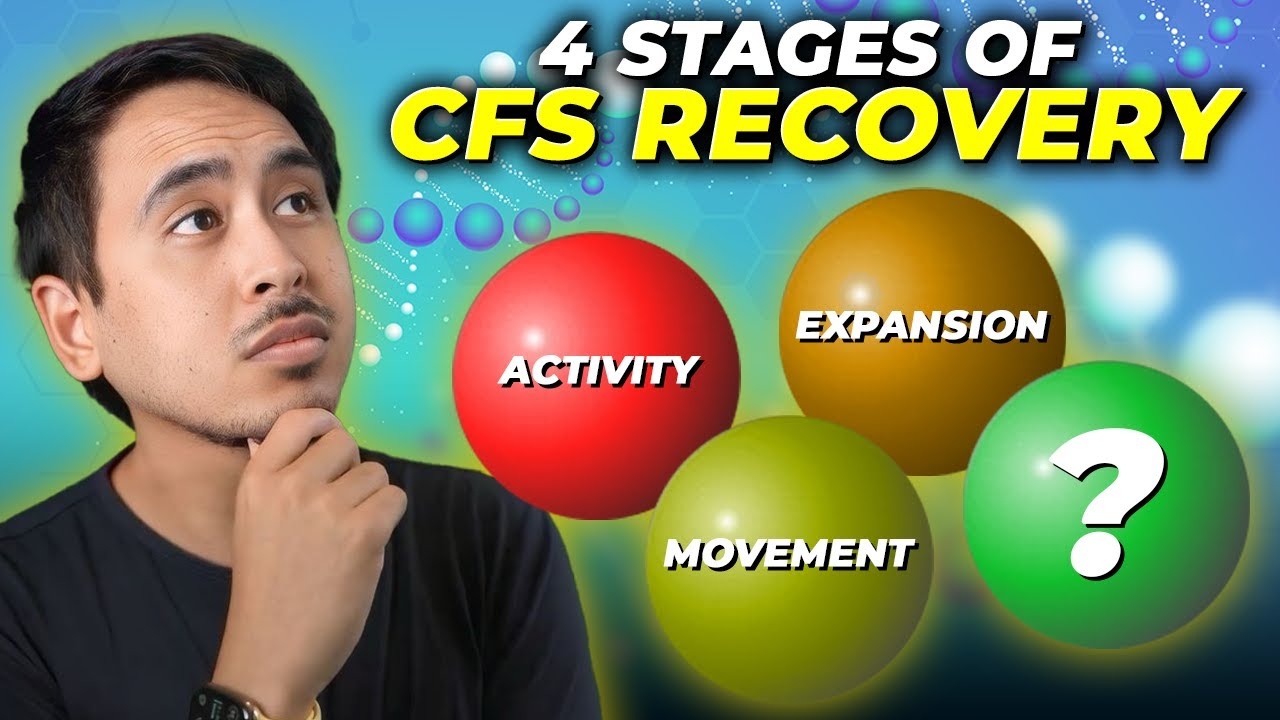
Watch: The 4 Stages of CFS Recovery Explained
TL;DR Summary
- Red stage: severely debilitated. Focus on mental rest and very gentle movement (sitting up, wheelchair, walker)
- Orange stage: wired-and-tired with adrenaline surges. Rest physically and mentally. Don't mistake adrenaline energy for genuine progress
- Yellow stage: true baseline revealed. Begin gentle, structured expansion with a 90/10 rest-to-expansion ratio
- Green stage: normal resilience. 80% active, 20% voluntary rest. Activity helps more than it hurts
- The expansion-to-rest ratio shifts gradually from 90/10 through 50/50 to 80/20 as recovery progresses
- What works in one stage can backfire in another. Know where you are before deciding what to do
Sources and References
- Porges SW. "The polyvagal theory: new insights into adaptive reactions of the autonomic nervous system." Cleveland Clinic Journal of Medicine. 2009. PubMed 19376977
- McEwen BS. "Physiology and neurobiology of stress and adaptation: central role of the brain." Physiological Reviews. 2007. PubMed 17615391
- Doidge N. The Brain That Changes Itself. Penguin Books, 2007. PubMed Review
- Shin LM, Rauch SL, Pitman RK. "Amygdala, medial prefrontal cortex, and hippocampal function in PTSD." Annals of the New York Academy of Sciences. 2006. PubMed 16855159