Walking With a Cane to Getting Her Life Back
"Now I walk up this double set of stairs, with no cane every Thursday at a meeting I go to with 50 other people and it doesn't feel abnormal anymore!"
Individual results vary. This is one person's experience and is not a guarantee of specific outcomes.
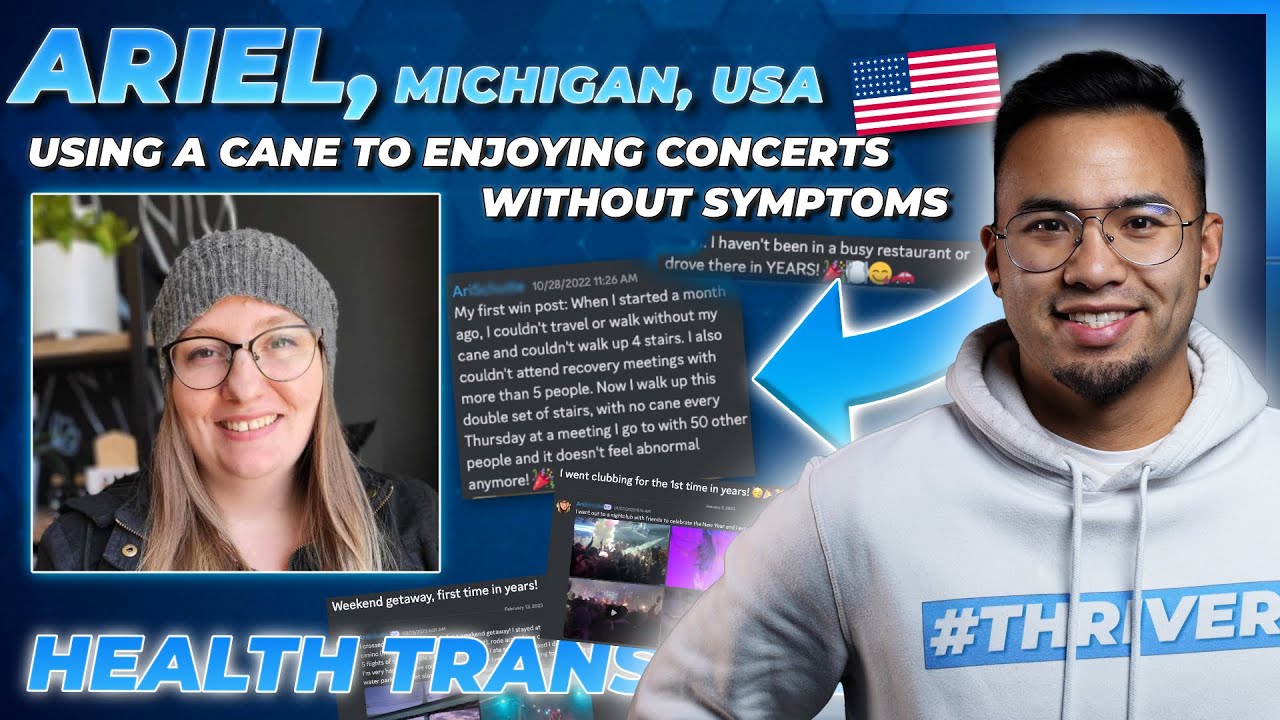
Watch Ariel's full recovery interview
Key Takeaways From Ariel's Recovery
| Condition: | CFS diagnosed at age 10, plus fibromyalgia and post-viral fatigue. Housebound and using a cane to walk for 20 years. |
| Treatments that failed: | Behavioral therapy, exposure therapy, functional medicine, restrictive diets, acupuncture, hypnosis, supplements, and stimulant medications. |
| What worked: | CFS Recovery's recovery system, built on nervous system retraining with live group coaching and community support. |
| Timeline: | Ditched the cane within 3 to 4 weeks. By month 3, attended a nightclub on New Year's Eve. By month 5, weekend getaways and water park rides. |
| Now: | Climbing stairs without vertigo, traveling spontaneously, eating without restrictions, and no longer overthinking every move. |
How Ariel's Chronic Fatigue Syndrome Started at Age 10
Ariel's symptoms started when she was just six or seven years old. She got sick constantly as a kid, always dealing with tonsil issues and ear infections. Doctors couldn't figure out why she could never keep her energy up. There was always a problem, always some infection.
By age 10 or 11, she was formally diagnosed with both ADHD and chronic fatigue syndrome. But at the time, doctors described CFS as a mental illness. They told a child to "stop stressing out." As she put it: "I was like ten or eleven. So that kind of went over my head."
Complex trauma and a missed diagnosis
Ariel went through significant complex trauma from a young age. The CFS diagnosis was treated like an afterthought, something tacked onto the ADHD. Doctors basically said, "Of course she's fatigued with everything else going on. Just get some rest." She was put on stimulants, and they hoped that would take care of it.
It didn't. The symptoms kept cycling through her teens and into her twenties. There were phases of gut issues, phases of mood problems, and fatigue that never went away. Most practitioners treated it like depression. The guidance she kept getting was to pull herself up by the bootstraps and push through.
How Bad Did Ariel's Symptoms Get?
At 17, Ariel got strep throat seven or eight times in a row. Her tonsils swelled so badly she stopped breathing in her sleep. She woke up in a panic and had to have emergency surgery. After that, she was diagnosed with post-viral fatigue for the first time, but again, doctors brushed it off. "Get some rest, you'll feel better soon."
Things got progressively worse. She was also diagnosed with fibromyalgia. Doctors suspected POTS. She couldn't hold down consistent work. At times she was working two or three jobs while in school, just trying to keep her head above water, all while her body was giving out.
When she joined CFS Recovery
By the time Ariel found the program, she was walking with a cane. Without it, she'd get vertigo so bad she'd lose her balance. Heart palpitations hit her day and night. Her anxiety was through the roof. Anything extreme would trigger a reaction: food too cold, food too hot, temperatures too high, temperatures too low.
The chemical sensitivities were some of the worst. When she moved in with her stepdad during a home renovation, she had to wear a full Tyvek suit, duct-taped at the seams, plus an N95 mask just to be around paint. She'd break out in rashes from building materials touching her skin. She used to run her own cleaning business. Now she couldn't hold a paintbrush.
What Treatments Did Ariel Try Before CFS Recovery?
Over 20 years of searching, Ariel tried just about everything. Behavioral therapy. Exposure therapy. Functional medicine. Restrictive diets where she cut out gluten, soy, dairy, and nuts. Acupuncture. Hypnosis. Supplements. Stimulant medications. She even tried having shamans dance around her and went through various religious services hoping for healing.
She tried a therapy where she had to scream out repressed emotions. That one actually caused a crash. As she described it: "It was very awkward. And exhausting." The emotional intensity was so taxing on her nervous system that it pushed her over the edge instead of helping.
She became a health coach trying to find answers
In March 2020, Ariel got certified as a functional medicine health coach. Not because she wanted to coach others, but because she wanted to be able to argue better with doctors. She was getting to the point where she couldn't get out of bed, couldn't drive, and couldn't work. She figured if she understood the science, maybe she could get someone to finally take her seriously.
She'd had the most luck getting compassion from holistic and integrative practitioners, so she completed a year-long certification in body medicine and functional medicine. It taught her more about her body, but it still didn't give her the answer she needed.
How Did Ariel Find CFS Recovery?
Ariel's friend Tammy had joined the Recovery Jumpstart program. They'd met through another program, and Ariel remembered the spot Tammy was in: not good. They'd have conversations in the fall wondering how they were going to get through it.
Then Tammy started changing. Fast. The progress Ariel saw in her friend went far beyond anything she'd witnessed in health coaching or patient advocacy. It was Tammy's real, visible results that finally convinced her.
Getting past the skepticism
Ariel was honest about her initial reaction to CFS Recovery's YouTube channel: "I've watched a lot of YouTube channels and they used to turn me off. I remember going to your channel and being like, there's no way that this is true."
She had a hard time watching positive recovery stories because she'd been let down so many times. Hope itself had become scary. But seeing Tammy's transformation up close made it real in a way that videos alone couldn't. She joined the program in October and committed fully from day one.
How Quickly Did Ariel's Recovery Progress?
Ariel's first big win came about 3 to 4 weeks in. There was a 12-step recovery meeting she used to attend that was up a set of stairs. She'd stopped going because she couldn't get up them. By this point she'd started to ditch the cane, and one day she forgot to bring it.
Instead of turning around, she went for it. She walked up two full sets of stairs. No vertigo. No lightheadedness. No heart palpitations. Nothing.
Before vs. after: Ariel's recovery by the numbers
| Area | Before Recovery | After 4 to 5 Months |
|---|---|---|
| Mobility | Walking with a cane | Climbing stairs, dancing, water park rides |
| Balance / Vertigo | Constant vertigo without cane | No vertigo, no lightheadedness |
| Sensory tolerance | Couldn't handle any extreme stimuli | Nightclubs with fog, lights, and loud music |
| Chemical sensitivity | Tyvek suit and N95 for paint exposure | No longer reacting to normal environments |
| Food restrictions | Eliminated gluten, soy, dairy, nuts. Meal prepped everything | Eating pizza at a pumpkin patch without planning |
| Travel | Couldn't ride 25 min in a car | 1.5-hour car rides, weekend getaways |
| Mental load | Constantly analyzing heart rate, energy, consequences | Intuitive, no longer overthinking |
New Year's Eve at a nightclub
About 3 months in, Ariel went to a nightclub on New Year's Eve. Not just any nightclub. This one had three or four sets of stairs across multiple levels, fog machines, flashing lights, loud music, and crowds of people everywhere.
She stayed for hours. She got on the dance floor. She went up and down stairs between different rooms. And the next day, instead of crashing, she just felt like someone who'd done something fun. Not someone who'd overdone it.
The pumpkin patch breakthrough
One of the most telling wins was a spontaneous trip to a pumpkin patch. An hour-and-a-half car ride to a place she'd never been, with people she'd never met. She didn't ask questions. She didn't plan her meals. She didn't control the variables. She ate pizza. She just had fun.
As Ariel explained, the reason it went so well was simple: "I didn't have time to anticipate all the things that could go wrong. I kind of just went for it."
Water park rides and weekend getaways
A couple of weekends before the interview, Ariel went on a full weekend getaway. She went to a casino. A surprise concert happened, and she stayed for it. And then she rode the biggest water park ride there.
That moment was emotional. She remembered being bedridden, sobbing, convinced she'd never ride a roller coaster again. A doctor had essentially told her she was stuck. And there she was, at the top of a water slide, choosing to go down it.
What Made CFS Recovery Different?
Ariel had tried other rewiring programs before. What set CFS Recovery apart was the community and live coaching. Being in a group with other people going through the same thing was something she'd never had before.
With other programs, she felt alone. She'd wonder: am I doing this right? What does it look like when other people do this? Am I ever going to meet anyone who actually understands? CFS Recovery's combination of group calls, coaching check-ins, and community support filled that gap completely.
Where Ariel is now
The biggest shift isn't physical. It's mental. Ariel doesn't overthink anymore. She used to plan everything obsessively: meal prep, bedtimes, eating schedules, every variable controlled. Now she trusts her body. She responds intuitively to how she feels, pulling back when she needs to, pushing forward when she can.
As she described it: "It is so relieving to not have to consistently be analyzing where am I and what's my heart rate. Am I able to do this? What are the consequences going to be? This is probably the first time in my life that I've not had that."
Her story is one of over 70+ documented recovery interviews from people across 20+ conditions who've gone through CFS Recovery's recovery systems. We've helped people as young as 9 and as old as 86, from 3 months to 50 years of illness.
Ariel's 1-Year Update: Life After CFS Recovery
One year after recovering from walking with a cane to getting her life back, Ariel returned to share how recovery has continued to unfold. Her journey didn't stop at getting better. It opened up a completely new chapter.
Ariel has since become a Thriver coach herself, helping others through the same recovery system that changed her life. She's studying integrative psychology and naturopathic medicine, turning her experience into a career dedicated to helping others heal.
The confidence she's built is something entirely new. As she puts it, this level of self-assurance wasn't something she was familiar with before recovery. It's not just about the physical symptoms being gone. It's about becoming someone stronger than who she was before.
Ariel's Message to People Still Searching
Ariel knows what it's like to be afraid of hope. She knows what it's like to see other people getting better and feeling like it'll never happen for you. She shared this for anyone in that place right now:
Ariel's Recovery Wins
Your Recovery Story Could Be Next
Ariel spent 20 years and tried everything from restrictive diets to shamans. Every person on our Recovery Stories page once felt exactly like you do now. Exhausted. Skeptical. Wondering if recovery was even possible.