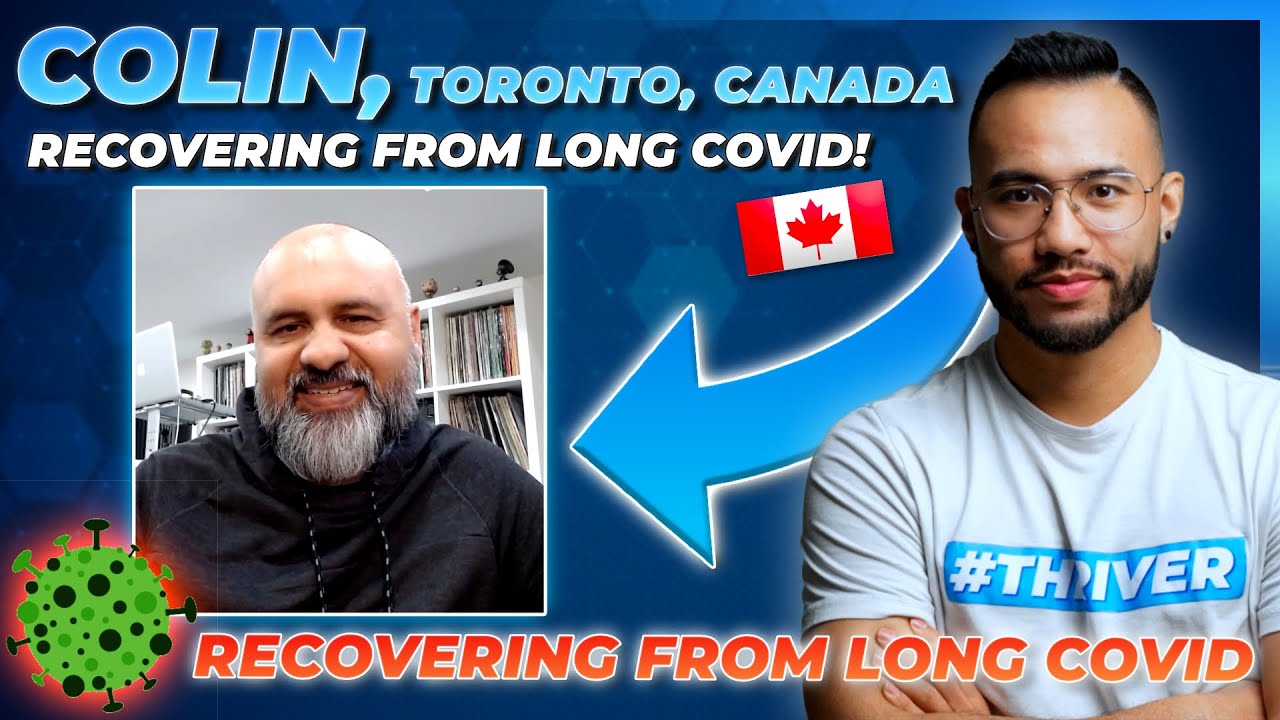
How Colin's Long COVID Started
Colin was the last person you'd expect to end up stuck on a couch. Before COVID, he was doing 5K walks every day, logging well over 10,000 steps, working out 2 to 3 times a week, mountain biking, playing basketball. He had a full-time job, three kids, and a packed schedule.
He caught COVID in September 2022. It felt like a mild chest cold. His whole family got it, and everyone bounced back quickly. A week later he tested negative and went back to normal life. But the cough wouldn't go away. He was getting short of breath. His asthma puffers weren't giving him the relief they usually did.
The first signs something was wrong
By October, things started to shift. His 5K walks got shorter. He was getting winded going up the stairs. Then the heart palpitations started. That was the scariest part.
Colin actually thinks he may have had COVID once before, in January 2020, before anyone knew what it was. He had a flu-like illness followed by weeks of unusual fatigue, but he came out of it. This time was different. This time, it kept getting worse.
Multiple ER Visits, Normal Tests, No Answers
Colin went to the ER in early October with his heart racing and severe shortness of breath. They ran bloodwork, an EKG, and a chest X-ray. Everything came back normal, except for an elevated inflammation marker. They sent him home.
Over the next 2 to 3 weeks, his physical ability dropped steadily. His walks got shorter. The stairs got harder. Then came the collapse.
Halfway through a walk to pick up his daughter from school, Colin had to stop. His wife was with him. His eldest daughter had to drive to pick him up. He barely made it from the car to the couch.
Back to the ER, still no answers
They went back to the ER in early November. This time they did a CT scan, another X-ray, and more bloodwork. Everything was normal again. The EKG showed premature ventricular contractions (his heart was firing a beat early), but the doctors said that's common with stress and not typically concerning.
The ER doctor mentioned he'd seen this in Long COVID patients and suggested seeing a cardiologist. But nobody gave Colin a concrete answer. Nobody said, "This is what's happening, and this is what to do about it."
The Long COVID Clinic That Made Things Worse
Colin found a government-approved long COVID clinic nearby. It was run out of a physiotherapy office. They told him they'd build him back up with a graded exercise program: lunges, planks, push-ups, and then an exercise bike at 85% heart rate for 15 minutes.
The first session felt okay. So he tried it again at home the next day. That night at 3 a.m., he woke up to something terrifying.
His doctor later told him he should have gone to the ER that night. The graded exercise approach pushed his already-dysregulated nervous system past what it could handle. This is a pattern we see often. Well-meaning clinics use exercise-based protocols that don't account for nervous system dysregulation. The body isn't deconditioned. It's stuck in a stress response.
When Scrolling Twitter Triggered Heart Palpitations
After the crash, Colin tried going back to work from home. He opened his email and started getting palpitations. He tried scrolling Twitter to pass time. Palpitations again.
The physical symptoms made some sense to him. He was sick, his body was recovering. But mental stimulation causing a physical reaction? That didn't compute.
This is one of the hallmark signs of nervous system dysregulation. Your body's threat detection system becomes so sensitive that even low-level mental stimulation, like reading emails or scrolling a phone, registers as danger. Your nervous system fires up the same stress response you'd get from a physical threat. It's not that your heart is broken. It's that your nervous system is stuck on high alert.
How Colin Found CFS Recovery
Colin was spending time on Reddit's long COVID forums, but the main sub was full of people saying recovery wasn't possible. He made a conscious choice to switch to the Long COVID recovery subreddit instead. That's where people were actually sharing stories of getting better.
On November 11th, he found a link to a video on Raelan Agle's channel featuring Junior from the CFS Recovery community. That video changed everything.
The YouTube videos that calmed his nervous system
Colin devoured the CFS Recovery YouTube channel. For the next three weeks, he'd do a bit of work, take a break, and watch an hour of videos. What happened next surprised even him.
Just watching the videos made his palpitations go away. He'd be at work, feeling them start, and he'd switch to a video. The calm explanation of what was happening in his body, the reassurance that recovery was possible, the specific scenarios that matched his experience exactly. It all brought his nervous system's temperature down.
By the end of November, Colin was walking around a mall with his wife. He had a great Christmas with his family. But he was still stuck in the push-crash cycle. He didn't know how to pace himself. He didn't know what was too much and what was the right amount. So in December, he crashed hard.
That's when he decided to join the program. He needed structure around his recovery.
What the Program Changed for Colin
Colin comes from a science background. He works in clinical trials. So the nervous system science made sense to him once he understood it. But what surprised him most was what actually helped the most.
The group calls he didn't want to do
When he signed up, Colin was skeptical about the group video calls. He figured he'd skip them and just get a workout plan. He didn't want to sit on a Zoom call with strangers.
Coaching that fills the gap doctors can't
Colin's second biggest takeaway was having a coach consistently in his corner. His doctor didn't know what to do with Long COVID. The ER gave him 5 minutes. But in the program, he had someone who understood exactly what he was going through. Someone who'd been through it themselves.
The coaches could guide him through specific scenarios without judgment. When he had a vulnerable moment, they didn't brush it off. They'd been there too.
Structure that turns scattered knowledge into a plan
Most of the concepts Colin learned are actually available on CFS Recovery's YouTube channel, scattered across hundreds of videos. The program took all of that and put it into a clear, structured recovery plan. Instead of piecing things together on his own, he had a step-by-step framework with coaching support at every stage.
The Business Trip That Changed Everything
A few months into the program, Colin had a business trip to San Francisco. It was his first trip since getting Long COVID. He was terrified.
To make matters worse, he'd thrown himself into an adjustment period just 10 days before the trip. He'd tried shoveling snow for 5 to 10 minutes (something he used to take pride in), and it triggered a flare-up. His previous adjustment periods in the program had lasted 10 to 12 days. The timing couldn't have been worse.
His mind spiraled. What if he crashed in the airport? What if he ended up on a bench like that day in November? Every coach told him the same thing: go on the trip.
The snack strategy that worked
Colin discovered that food played a big role in helping him through adjustment periods. Before Long COVID, he'd been into intermittent fasting and calorie restriction. His coaches joked with him: just pack your snacks. So he ate his way through the trip on a 2 to 3 hour snacking schedule.
He got up at 5 a.m. Got to the airport. Six-hour flight. No problem. He was reading his book, eating, feeling fine. Then came the work dinner at a Michelin-star restaurant. That's where the shift happened.
He woke up the next morning and felt better. The adjustment period was over. He'd come out of it during a business trip he was terrified to take. The rest of the trip was great. He was socializing, going out with colleagues, living his life.
What that win unlocked
After the trip, Colin stopped saying no to things. Movies, dinners, social events. None of it scared him anymore.
His win rippled through the community too. People in his cohort saw what he'd done and started having their own breakthroughs. One thriver had a trip planned and went for it because Colin had shown it was possible. That's the power of community proof: when one person breaks through, it gives everyone else permission to believe they can too.
Colin's Recovery: Before vs. After
| Metric | Before Recovery | After 3 Months |
|---|---|---|
| Daily activity | Couch-bound, couldn't walk to kitchen | Business trips, social events, full days |
| Heart palpitations | Triggered by email and scrolling | Resolved through brain retraining |
| Work | Taking days off, couldn't look at screen | Full-time with business travel |
| Social life | Isolated, couldn't leave house | Dinners, movies, socializing freely |
| Medication | On medication | Medication-free |
| Mental state | Health anxiety, constant fear spirals | Confident, emotionally open, resilient |
The Emotional Side of Recovery
One thing Colin didn't expect was the emotional growth that came with recovery. Before getting sick, he'd always had trouble expressing emotions. He'd push feelings down instead of acknowledging them. He believes that pattern may have contributed to his nervous system getting stuck in the first place.
Through the program, he started allowing himself to feel things. Seeing wins posted by other community members, especially people who'd been sick for 10 or 15 years, moved him deeply. He started writing in a journal. He stopped suppressing.
Where Is Colin Now?
Colin is back to living his life. He's working full-time, traveling for business, and saying yes to everything again. He stopped taking his medication and hasn't looked back. Social activities are a "no-brainer" now. He's rebuilding his exercise routine, which is the last piece of his recovery.
His story is one of over 70+ documented recovery interviews from people across 20+ conditions who've gone through CFS Recovery's recovery systems. Every person on that page once felt exactly like you might feel right now: exhausted, scared, and wondering if recovery is even possible.